Community Trust ScoreVerified
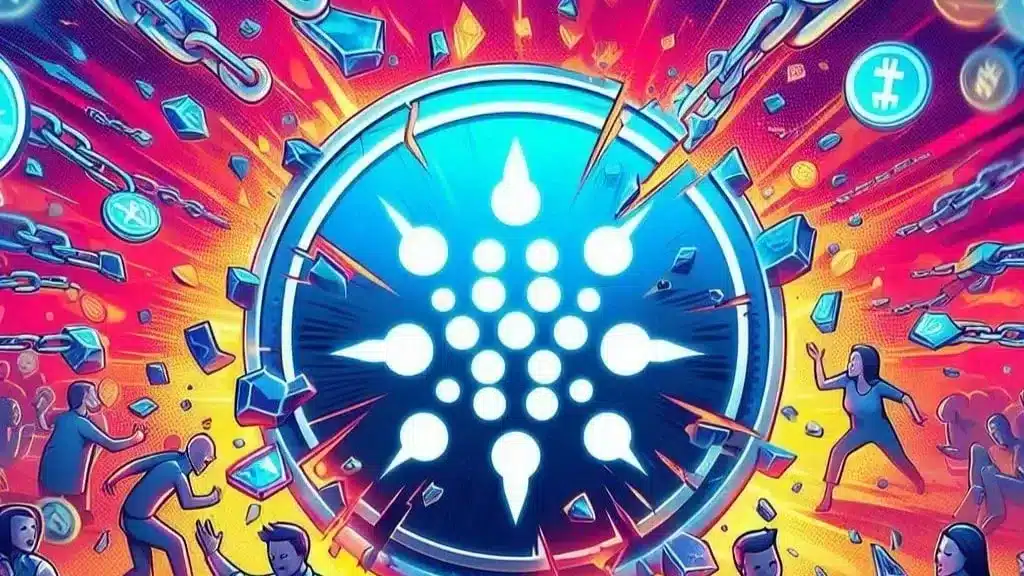
Cardano has entered one of the most turbulent moments in its eight-year history after a single malformed transaction caused the blockchain to split into two competing chains, disrupting exchanges, DeFi applications, and network tools across the ecosystem. The incident, which briefly fractured the $14 billion network, is being called the most severe failure since Cardano launched in 2017.
According to Intersect — the organization overseeing Cardano ecosystem governance — the event was triggered by a long-standing bug in node software related to delegation transactions. The flawed transaction was accepted by some newer nodes while being rejected by older nodes, resulting in two versions of the ledger operating at the same time on the Cardano mainnet.
The situation raised immediate alarm because the same vulnerability had been observed on the Cardano testnet roughly 24 hours earlier, indicating that the exploit was probed before being applied to the live network. Although block production continued on both chains, the presence of two parallel ledger states disrupted virtually every user-facing service.
Exchanges halt operations as data becomes unreliable
Major exchanges reacted quickly to the developing situation to avoid accidental settlement on a chain that could later be discarded by consensus. Binance Japan, Upbit, Kraken, and others temporarily paused deposits and withdrawals, with Coinbase imposing the longest freeze of roughly 14 hours while it monitored chain convergence.
Block explorers also struggled to evaluate ledger accuracy, in some cases freezing or returning contradictory information due to the split state of the network. Smart contracts faced the same complications: a contract execution on one chain did not always guarantee the same transaction outcome on the competing branch, prolonging settlement times and causing widespread transaction failures.
Emergency coordination unfolded among Input Output Global (IOG), EMURGO, Intersect, and the Cardano Foundation. Within hours, developers shipped patches to align node behavior and encourage consensus, and by Nov. 22 the network eventually reconverged on a single canonical chain without manual intervention.
However, the damage to market confidence was already visible. ADA declined as much as 16% during the event, stabilizing later near $0.41.
Developer apology meets fierce pushback from Hoskinson
The chaos took a dramatic turn when an X user known as “Homer J” publicly claimed responsibility for submitting the transaction that triggered the split. In a lengthy apology, the developer described the event as a misguided “personal experiment” aimed at replicating the bug rather than disrupting the network. They admitted that poor server firewalling contributed to the vulnerability being exploited unintentionally.
Cardano founder Charles Hoskinson rejected this explanation immediately. In a widely shared post, he labelled the incident a premeditated attack, arguing that the exploit was deliberately tested on testnet before being executed on the mainnet. Hoskinson said the situation had already been escalated to law enforcement, including the FBI.
Intersect later distributed a fact sheet confirming that notifications to authorities were underway. This accelerated a wave of fear across community channels as builders questioned the line between accidental research and criminal responsibility.
Resignation inside IOG reveals deeper cultural pressure
The fallout did not stop at public tensions. Roman — an IOG Plutus language engineer known in developer circles as “effectfully” — announced his resignation shortly after Hoskinson’s comments. He expressed concern that normal vulnerability-research behavior could now expose developers to legal risk.
In his statement, Roman said he had previously taken part in simulated cyberattack exercises and contributed to identifying weaknesses in Cardano’s computational layer. Now he feared that working on such areas could be interpreted as intent to cause damage rather than routine security improvement.
His resignation has ignited debate over the future of open-source collaboration in the Cardano ecosystem. Some fear that intense backlash to mistakes — whether malicious or not — could deter developers from contributing to core infrastructure, reducing the pace of innovation.
A technical crisis becomes a governance crisis
Although the network has stabilized, deeper questions are now being raised about Cardano’s governance model, particularly around software audits, coordination between ecosystem pillars, and disaster response protocols. The exploit existed for three years without being addressed, and critics argue that the chain split could have been avoided with a more proactive code review process.
The event has also highlighted bottlenecks in Cardano’s decision-making structure. Rescue efforts required coordination among IOG, the Cardano Foundation, EMURGO, and Intersect, delaying early communication and confusing ecosystem service operators.
Meanwhile, community sentiment remains mixed. Some believe Hoskinson’s aggressive language against the developer was crucial to protecting the integrity of the network. Others argue that escalating to criminal proceedings may discourage security research and contribute to a culture of fear.
What comes next for Cardano
Cardano now enters a period of introspection. While the network technically survived the incident — continuing block production and eventually stabilizing through consensus — the episode exposed vulnerabilities not only in code but in the ecosystem’s culture and crisis management strategy.
Developers are calling for deeper dynamic testing across node versions, increased rewards for responsible disclosures, and clearer rules of engagement for researchers probing possible vulnerabilities. Others are urging a formal review of governance procedures to ensure faster emergency coordination during future incidents.
Investors and users are waiting for clarity, both on the technical future and on whether legal actions against those involved will reshape the tone of Cardano’s development environment.
The blockchain avoided a shutdown, but the chain split has left behind a much more complicated conversation — one that will determine how Cardano evolves from here.