


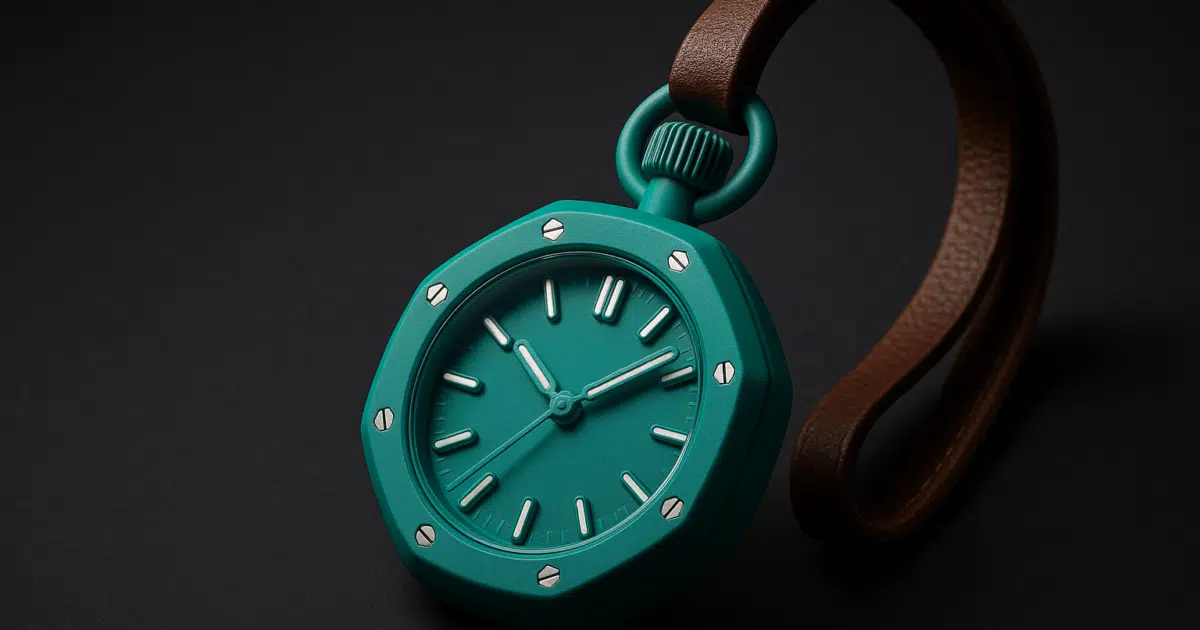
On Saturday 16 May 2026, Audemars Piguet — the haute horlogerie maison whose Royal Oak set the template for the luxury sport-watch category in 1972 — released a $300 collaboration with Swatch. Eight colourways. Lanyard format, not wristwatch. Bioceramic case. The release was the most polarising luxury-watch moment of the decade, and it triggered a multi-day debate across crypto, fashion, and traditional watch communities about what brand authority means in 2026.
Swatch × Audemars Piguet Royal Pop
★★★★ 4.2 / 5 (Cultural impact: ★★★★★)
Reviewed by The Currency Analytics — June 2026
This piece reviews the Royal Pop collaboration on three layers: as a physical product, as a cultural event, and as a signal about what Audemars Piguet thinks about brand extension in the post-Swatch-MoonSwatch era.
What the Royal Pop Is — And What It Is Not
The Royal Pop is a pocket-watch-format quartz timepiece. It carries the octagonal silhouette of the Audemars Piguet Royal Oak, the eight visible screws around the bezel, and the AP × Swatch co-signature on the dial. It does not come on a steel bracelet; it ships with a calfskin lanyard. It is sold at $300, distributed exclusively through Swatch boutiques, and was limited by per-customer purchase caps to manage demand.
Eight colourways were released:
- Ocho Negro — monochrome black
- Otg Roz — bright pink
- Otg Yelo — saturated yellow
- Otg Teal — vivid teal
- Otg Pulp — coral orange
- Otg Verde — green
- Otg Blue — primary blue
- Royal Cream — off-white
Quick Facts
| Brands | Audemars Piguet × Swatch Group |
| Release date | 16 May 2026 |
| Format | Pocket-watch with calfskin lanyard (not wristwatch) |
| Case material | Bioceramic (Swatch proprietary) |
| Movement | Quartz |
| Diameter | ~41.5 mm |
| Retail price | $300 / €300 / equivalent |
| Distribution | Swatch boutiques only — not AP boutiques |
| Secondary market (Week 1) | $800–$2,200 depending on colour |
Why the Crypto Community Reacted So Strongly
The Royal Pop release was particularly polarising in the crypto and NFT community. For five years, the Royal Oak — particularly the Royal Oak Offshore and Royal Oak Concept — had functioned as a status object for crypto wealth. A Royal Oak 15500ST on the wrist signalled having “made it” without being as ostentatious as a Jacob & Co. or as old-money as a Patek.
When AP released a $300 lanyard pocket-watch in the same silhouette, the signalling value of the actual Royal Oak was, in the eyes of some crypto holders, partially diluted. The Protos headline “AP just rugged crypto bros with a Swatch collab” captured the prevailing sentiment in the first 48 hours. The argument: AP had used its scarcity-based brand equity — earned by decades of waitlists and allocation control — to mass-produce a $300 item that anyone could buy.
The counter-argument, reflected in WatchTime and CNN coverage, was that the Royal Pop expands AP’s audience without affecting Royal Oak demand or pricing. Secondary-market Royal Oak prices held within trading range in the weeks following the release. The Royal Pop was a marketing event, not a product-line decision.
What the Royal Pop Signals About Luxury Watchmaking
Swatch had already proven, with the MoonSwatch (Swatch × Omega, 2022), that a $300 collab with a Swatch Group sister brand could generate the most disruptive watch retail moment of the year. The MoonSwatch sold over a million units in its first 18 months. The Royal Pop replicates the formula at a higher symbolic stakes — Audemars Piguet is not a Swatch Group brand, and Royal Oak waitlists are far more restrictive than Speedmaster.
For other independent maisons watching the Royal Pop reception, the takeaway is structural: Swatch can now credibly partner with brands outside its own group. Patek Philippe, Vacheron Constantin, Rolex — none of these have done a Swatch collab. After the Royal Pop, none can claim it is unthinkable.
Pros
- Genuine cultural event — buyers who acquire one early own a moment in luxury-watch history
- Eight colourways cover most personal palettes
- Bioceramic case is a real material, not a plastic substitute
- $300 entry price is genuinely accessible
- Royal Oak octagonal silhouette is one of the most recognisable in watchmaking
- Strong resale market in Week 1 (though normalising fast)
Cons
- Pocket-watch / lanyard format — not a wristwatch — limits daily use
- Quartz movement is functionally correct but emotionally distant from haute horlogerie
- Brand-dilution concerns for existing Royal Oak owners
- Secondary-market pricing already normalising — speculation window is closing
- Distribution friction — Swatch boutique-only requires in-person purchase, no e-commerce
Who Should Care
The Royal Pop matters most to two audiences. First, watch collectors who track cultural moments — owning one is a way to document the May 2026 retail event. Second, crypto holders who are decidedly not moving to Patek Philippe and want a $300 statement piece that signals participation in the luxury conversation without the $30K acquisition friction. It matters less to traditional Royal Oak collectors, for whom it is at best a curiosity.
🎯 The Currency Analytics Verdict
Rating: 4.2 / 5 (Cultural impact: ★★★★★)
The Swatch × Audemars Piguet Royal Pop is more important as a cultural event than as a watch. The collaboration confirms that Swatch can credibly partner outside its own group and resets expectations for what “luxury brand accessibility” means in 2026. For crypto holders, it offers a $300 way to participate in the AP conversation without the Royal Oak waitlist. The lanyard format is the dealbreaker for some; for others, the cultural moment is the whole point.
Pricing and secondary-market values reflect publicly available data as of June 2026 and shift rapidly in the months after release. The Currency Analytics maintains editorial independence. This is informational, not financial, investment, or collecting advice.


