Community Trust ScoreLikely Real
Tom Lee thinks September fear is the trade. The Fundstrat strategist sees the current wave of market anxiety as a contrarian signal — one that could push stocks sharply higher and send Bitcoin nearly doubling from where it sits today.
Why It Matters
The anticipation surrounding the Federal Reserve's September 15 meeting underscores the broader influence of monetary policy on cryptocurrency markets, particularly Bitcoin. As investors grapple with market volatility and economic indicators, sentiments like those expressed by Tom Lee may reflect a growing trend of viewing Bitcoin as a hedge against traditional market uncertainties. This dynamic highlights the interconnectedness of crypto assets with macroeconomic factors, suggesting that significant policy decisions could further shape market trajectories in the coming months.
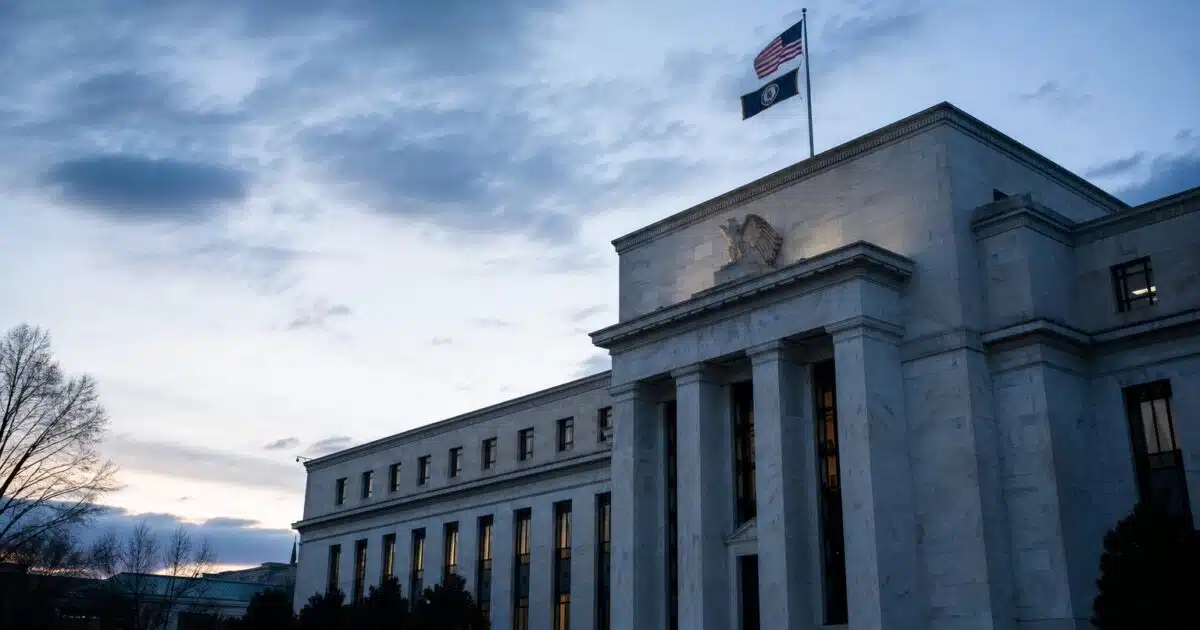
Lee hasn’t dropped his correction call entirely. But he’s zeroed in on one date: the Federal Reserve meeting on September 15. Whatever comes out of that room probably shapes everything else for the rest of the year.
Why September Looks Different This Time
History gives Lee some cover here. In the ten U.S. midterm election years going back to 1986, stock market lows hit around September 2, on average, following declines of roughly 16.77% from prior peaks. That’s a pretty consistent pattern. And right now, the setup feels familiar — fear is thick, headlines are grim, and most retail investors seem convinced a crash is coming.
But this year’s got extra complications. Three Fed presidents backed a rate hike back in July. Chair Kevin Warsh used his Jackson Hole speech to hammer home inflation control as the central priority. Six-month PCE inflation sat at 4.1%. The 30-year Treasury yield has stayed stubbornly above 5%. Meanwhile, the effective Fed funds rate is running around 3.63% — a gap that makes the policy picture murky at best.
Lee’s base case is that all this anxiety converges into a 10% equity drop first. Short, sharp, painful. Then — if the Fed holds steady at September 15 and neither hikes nor cuts — he thinks markets snap back hard. A real rally, not just a dead-cat bounce.
If the selloff bleeds into October, he sees the S&P 500 potentially starting that month somewhere above 8,000, with a possible floor near 7,300. Not a collapse. A dip, then a rip.
Bitcoin at $150,000: Lee’s Four Catalysts
Bitcoin sat near $78,875 at last check, up a modest 0.3% over 24 hours. It’s still roughly 37% below its October 2025 peak. Not exactly inspiring on the surface.
Lee doesn’t see it that way. He thinks the past year’s weakness in crypto came from forced selling — liquidations, deleveraging, funds blowing up — not from anything broken in the underlying fundamentals. That’s a meaningful distinction. Forced selling ends. Broken fundamentals don’t.
He’s got four specific things he’s watching that could flip the script.
First, crypto outperformed every other major macro asset class in Q3. That’s not nothing. Second, Lee believes the four-year crypto cycle is approaching its end, which historically sets up the next big leg higher. Third, Korean traders — who rotated heavily into AI stocks — are apparently starting to rotate back into crypto. And fourth, the possible passage of the CLARITY Act, U.S. legislation aimed at laying out a clearer regulatory framework for digital assets, could be a major confidence booster for institutions sitting on the sidelines.
On top of those four, institutional crypto ETF inflows are climbing. Bigger players seem to be positioning. Lee reads that as smart money getting ready for a strong Q4.
Put it all together and he’s calling $150,000 Bitcoin. Nearly double from current levels. Alongside that, he’s got an S&P 500 target above 8,200, driven by rising earnings estimates.
Jobs Data and Rate Hike Fears
There’s one more piece Lee keeps coming back to: the upcoming jobs and inflation data. Weak numbers there could basically kill any remaining market expectation of a rate hike. And if traders fully rule out a hike, the relief rally he’s predicting gets a lot easier to imagine.
It’s a scenario where bad economic news is actually good market news — the classic Fed-pivot trade, or at least the fear-of-no-hike trade. Unclear exactly how weak the data needs to be to move the needle, but Lee seems to think the threshold isn’t that high given where sentiment already is.
Institutional interest keeps showing up as a thread through his whole argument. The ETF inflows aren’t just a footnote — they’re kind of central to his thesis. If large allocators are genuinely moving money into crypto ahead of Q4, that’s a supply-demand story that doesn’t need a macro catalyst to work. It just needs the selling pressure to stop.
And Lee thinks the selling pressure is mostly done. The forced liquidations that dragged crypto down over the past year weren’t a sign of a dying asset class. They were a clearing event. Painful, yes. But probably necessary.
The CLARITY Act angle is worth watching closely. Regulatory uncertainty has kept a lot of institutional capital on the bench for years. If Congress actually moves something through that defines who oversees what in digital assets, the compliance departments at major funds get a cleaner green light. That changes the math for a lot of potential buyers.
Lee’s S&P target above 8,200 comes with climbing earnings estimates as the backbone. Not just hope — actual analyst revisions moving higher. That’s the fundamental underpinning he’s leaning on while everyone else stares at the September calendar and panics.
Bitcoin near $78,875. S&P potentially above 8,200. Fed meeting September 15.
Frequently Asked Questions
What price does Tom Lee predict for Bitcoin?
Tom Lee predicts Bitcoin could reach $150,000, nearly doubling from its current price near $78,875, which sits about 37% below its October 2025 peak.
What are the four catalysts Tom Lee cites for a Bitcoin rally?
Lee points to crypto’s leading macro asset performance in Q3, the end of the four-year crypto cycle, Korean traders rotating back from AI stocks into crypto, and the potential passage of the CLARITY Act as the four key drivers.