Community Trust ScoreVerified
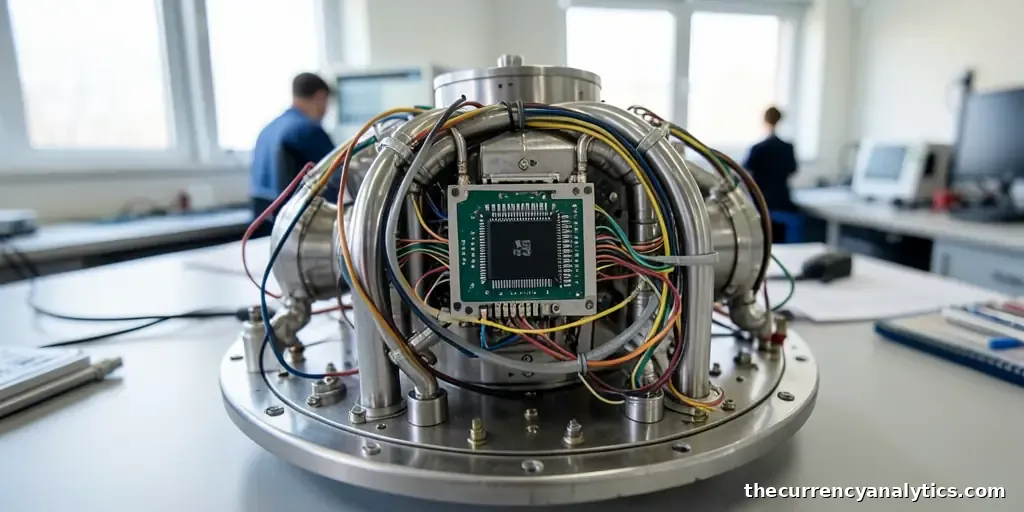
Google’s Willow quantum processor recorded a 98.3% success rate in the Mermin-Peres magic square game, a benchmark that exceeds the 88.9% limit imposed on classical systems. The result appears in a study published in Science on Thursday, detailing how the hardware demonstrated quantum contextuality through specific coordination tasks.
More coverage is filed under Finance.
The experiment tested whether measurement outcomes depend on what else is measured alongside them. In the magic square game, two players fill intersecting parts of a three-by-three grid without communicating. A prearranged classical strategy can succeed on no more than eight of nine assignments, setting the ceiling at 88.9%. Entangled qubits can theoretically win every round, but hardware noise prevented the Willow processor from reaching the 100% quantum ideal.
Hardware performance in specific benchmarks
Google ran the four-qubit magic square game across 900,000 trials to establish the success rate. The researchers noted that the qubits coordinated better than any pre-written table allows. They explained that in this context, “you cannot assign fixed, pre-existing values to everything you might measure.”
Separate tests pushed the processor to higher qubit counts. A GHZ parity game asked up to 71 entangled qubits to deliver coordinated binary answers. The classical winning rate limit for this game is 50%, and Google remained above that threshold despite accumulating hardware noise. Additionally, researchers verified genuine entanglement across 45 qubits.
In a hidden linear function task involving 105 qubits, a shallow quantum circuit had to produce a binary string satisfying mathematical constraints. The processor achieved a 60% success rate in this benchmark. However, the largest instance of this task failed in about four out of 10 runs. This 105-qubit benchmark uses a conjectured classical bound and does not establish fault-tolerant computing. The result does not mean Google has a commercial quantum computer, as the 105-qubit run tested a different, more limited challenge than the four-qubit magic square game.
Error detection and contextuality scores
The tasks exposed small, systematic errors that conventional randomized tests can hide. Google described the work as providing “a sensitive new method to catch subtle hardware errors.” Contextuality testing may help engineers evaluate circuits used for chemistry and materials research.
For the contextuality measurement, the classical score limit is 4, while quantum theory allows a score of 6. Willow registered a contextuality score of 5.590, with an uncertainty of 0.008. The work follows Google’s October report of a 40-fold error reduction in preparing magic states, a resource needed for fault-tolerant quantum computing.
A future fault-tolerant quantum computer could break digital signatures, which is a looming danger for Bitcoin. The 105-qubit task was a shallow mathematical circuit, and the hardware’s performance in these specific coordination games provides data on current error rates and entanglement verification capabilities.