


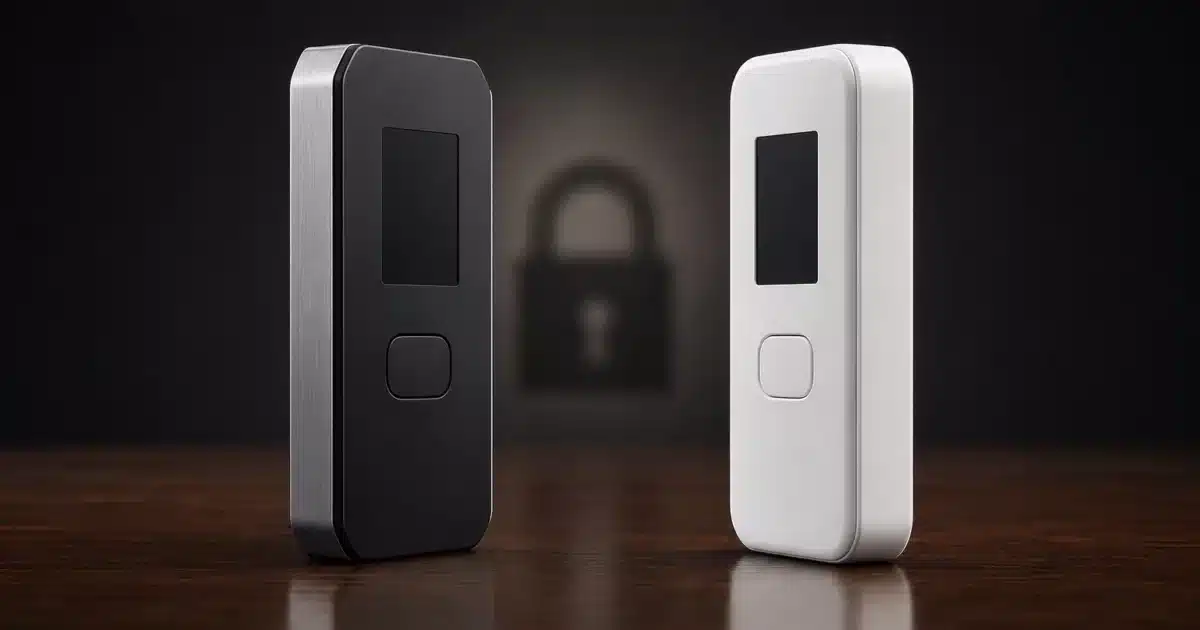
Every serious crypto holder eventually has the same realization: coins sitting on an exchange aren’t really yours. When that day comes, the shortlist almost always reads Ledger or Trezor — the French company that put a bank-grade chip in a USB stick, and the Czech team that invented the hardware wallet category in the first place.
Both do the core job well: your private keys never touch the internet. The differences live in philosophy — closed-source chip versus open-source everything — and in the small daily details that decide whether you’ll actually enjoy using the thing.
| Aspect | Ledger | Trezor |
|---|---|---|
| Founded | 2014 (France) | 2013 (Czech Republic, SatoshiLabs) |
| Device price range | ~$79 (Nano S Plus) to ~$399 (Stax) | ~$49 (Model One) to ~$249 (Safe 5) |
| Security approach | Secure element chip, closed-source firmware | Fully open source; EAL6+ chip on Safe series |
| Coins supported | 1,800+ | 1,000+ |
| Companion software | Ledger Live (desktop + full mobile app) | Trezor Suite (desktop-first) |
| Staking | Built into Ledger Live | Mostly via third-party integrations |
| Best for | Mobile users, big multi-coin portfolios | Open-source purists, bitcoin-first holders |
Price & Everyday Use
Neither company charges you to use your own wallet — you pay once for the device. Trezor’s entry point is lower: the Model One still does the essential job for around fifty dollars. Ledger’s Nano S Plus at roughly eighty is the better-equipped starter, and prices climb from there toward touchscreen territory on both sides.
Day to day, the real gap is mobile. Ledger Live is a genuinely complete app — buy, swap, stake and check your balance from your phone with the device in your pocket. Trezor remains desktop-first: Trezor Suite is excellent on a computer, but iPhone users especially will feel the limitation. If you manage your portfolio from your phone, that alone may settle the question.
Security
This is where the two philosophies split cleanly. Ledger builds around a certified secure element — the same chip family used in passports and bank cards — but keeps parts of its firmware closed. The 2023 “Ledger Recover” episode, when the company announced an optional seed-backup service many users felt contradicted the whole point of a hardware wallet, still colors how some of the community sees it. The service is opt-in and the devices were never breached, but trust bruises heal slowly.
Trezor took the opposite bet: publish everything and let the world audit it. For years the trade-off was the absence of a secure element (older models could be physically attacked with lab equipment), but the newer Safe 3 and Safe 5 closed that gap with an EAL6+ certified chip — while staying open source. Add Shamir backup, which lets you split your recovery phrase into multiple shares, and Trezor’s security story has never been stronger.
Coins & Features
Ledger supports over 1,800 assets and the integrations are broad: most DeFi front-ends, NFT marketplaces and L2s connect to a Ledger without friction. If your portfolio spreads across a dozen chains, Ledger Live keeps it manageable in one place, staking included.
Trezor covers the majors — Bitcoin, Ethereum and the large caps are all first-class citizens — but exotic chains sometimes require third-party wallets. Where Trezor shines is bitcoin-specific tooling: coin control, Tor support and clean multisig make it a quiet favorite among BTC maximalists.
Which One Should You Choose?
Buy a Ledger if you hold many different assets, manage things from your phone, or want staking without extra software. The Nano X is the sweet spot for most people.
Buy a Trezor if open source is a requirement rather than a preference, if your portfolio is mostly bitcoin, or if you want Shamir backup for your recovery phrase. The Safe 3 is the best value in hardware wallets right now.
And if you’re leaving significant money on an exchange while you decide — read our exchange comparison, then come back. Either of these devices beats the safest exchange.
FAQ
What is the main security difference between Ledger and Trezor?
Ledger pairs a certified secure element with partly closed firmware; Trezor is fully open source and added an EAL6+ chip on its Safe series. In practice both are safe for normal users — the choice is between trusting a certified chip vendor and trusting public code audits.
Can I stake with both devices?
Ledger has staking built into Ledger Live for ETH, SOL, DOT and others. On Trezor, staking generally goes through third-party interfaces, which works but takes more steps.
Does the 2023 Ledger Recover controversy make Ledger unsafe?
No breach ever occurred and the service is strictly opt-in. The controversy was about trust and communication rather than a technical failure. Users who dislike the idea simply never activate it.
Which wallet supports more cryptocurrencies?
Ledger, with 1,800+ assets against Trezor’s 1,000+. For large-cap portfolios both are fine; for long-tail altcoins, check Trezor’s compatibility list before buying.
This comparison is for information only and is not financial advice. Verify prices and supported assets on the official Ledger and Trezor sites before purchasing.
Read also: Bitcoin (BTC) Live Price
See also: Binance vs Kraken: Fees, Security & Which to Choose
More comparisons: Coinbase vs Binance · Coinbase vs Kraken · Bybit vs Binance