Community Trust ScoreVerified
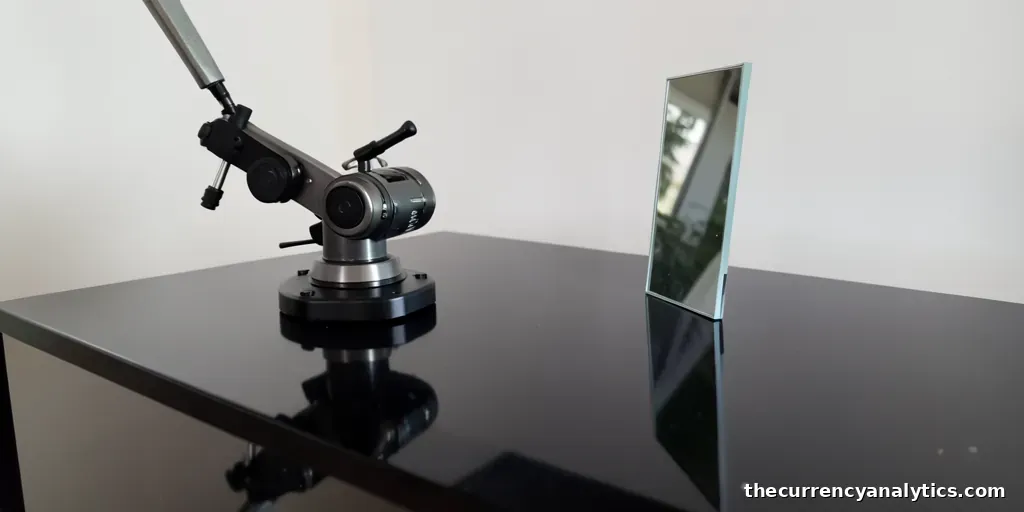
Two AI robot controllers, π0.5 and FastWAM, completed zero out of ten block-stacking attempts when the workspace was placed on a mirrored tabletop, according to a Nov. 24 preprint by researchers at Peking University. On a standard, non-reflective surface, both systems successfully stacked blocks in eight out of ten trials. The study quantifies how visual reflections interfere with the decision-making processes of physical and simulated robotic agents.
More coverage is filed under Technology.
Physical Trials Show Total Failure
The research team conducted physical trials using a Franka arm for both sets of tests. Each controller was subjected to four specific tasks: placing produce, stacking blocks, flipping a bracket, and inserting a cylinder. To ensure consistency, the researchers maintained the same camera setup, instructions, and execution budget across all conditions. Each controller attempted every task ten times in each condition, utilizing five distinct starting layouts, with each layout used twice.
The results for the two physical controllers, π0.5 and FastWAM, revealed a sharp decline in performance as reflective elements were introduced. Without any mirrors, π0.5 achieved a success rate of 77.5%, while FastWAM managed 60%. When an upright mirror was positioned beside the workspace, π0.5’s success rate dropped to 52.5% and FastWAM’s fell to 30%. The most severe degradation occurred with the mirrored tabletop, where π0.5’s success rate plummeted to 27.5% and FastWAM’s to 10%. In the specific block-stacking task, the failure was absolute for both systems on the mirrored surface, with zero successful stacks out of ten attempts.
Simulation Data Confirms Pattern
The study also evaluated five simulated controllers using the RoboDojo-Mirror benchmark across eight shared tasks. In every mirror setup tested, including a single upright mirror, two mirrors, and a mirrored tabletop, the overall success rate for every controller was lower than in their respective mirror-free runs. The researchers compared each controller against its own baseline without mirrors because the systems operated under different execution budgets.
To isolate the effect of reflection from the physical presence of an object, the team ran a simulated comparison using non-reflective panels of the same shape and placement as the mirrors. An upright mirror serves not only as a visual disruptor but also as a physical obstacle. Across 120 comparison pairs for the WALL-OSS controller, the system succeeded only with the panels in 25 pairs and only with the mirrors in two. For the Awomo-0.5 controller, the counts were 42 pairs succeeded only with panels and three pairs succeeded only with mirrors across its own 120 comparison pairs.
Further analysis focused on matched pairs where the robot touched the surface in both trials, succeeded with the panels and in the mirror-free baseline, but failed with the dual mirrors. This subset included six matched pairs for WALL-OSS and seven for Awomo-0.5. In these specific instances, the robot spent a greater share of the trial duration touching the mirrors than the panels. The researchers noted that mirror trials still failed more often in the subset where the robot succeeded in the mirror-free baseline and touched neither the mirror nor the non-reflective panel, indicating that the failure mechanism extends beyond simple physical collision.
Visual Confusion in Gripper Control
The study highlights specific instances of visual confusion that lead to task failure. In one simulated tube pickup task, the gripper closed away from the target tube and lifted empty-handed, suggesting the controller was reacting to a reflection rather than the physical object. The researchers stated that the observed patterns were consistent with attempts to reach a reflection rather than the actual item. The data demonstrates that even when a robot does not physically interact with a reflective surface, the presence of that surface can degrade performance by introducing misleading visual cues into the controller’s perception loop.