Community Trust ScoreVerified
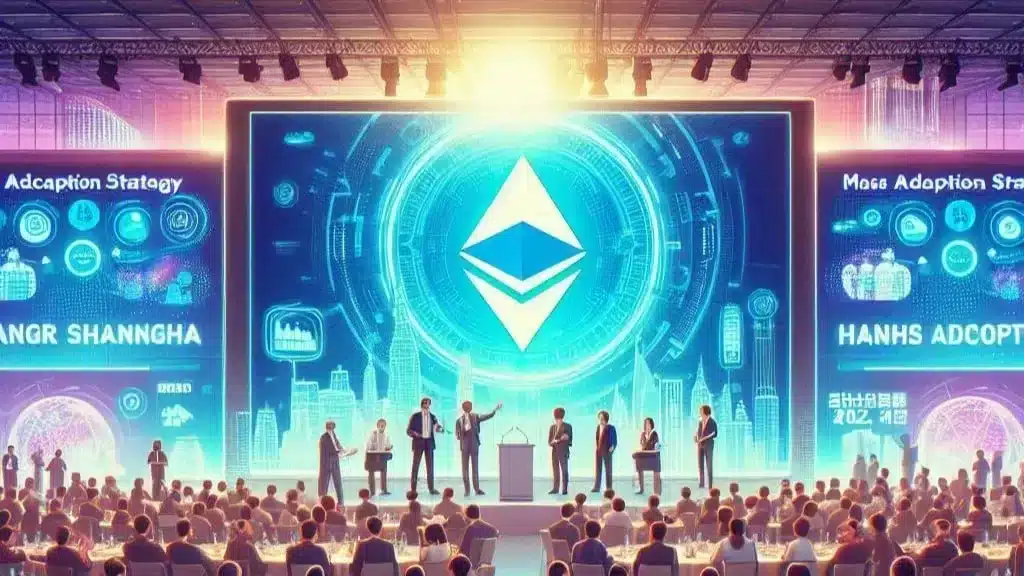
At ETHShanghai 2025, Ethereum Foundation leaders outlined a comprehensive strategy aimed at accelerating Ethereum’s global adoption. Hsiao-Wei Wang, Co-Executive Director of the Ethereum Foundation, emphasized that Ethereum’s long-term vision focuses on three pillars: user self-control, global settlement capabilities, and seamless everyday utility.
The forum highlighted Ethereum’s ongoing efforts to improve scalability, enhance user experience, and foster trust across its network. These initiatives are designed to remove barriers that have slowed blockchain integration in real-world applications, positioning Ethereum as a core infrastructure for decentralized finance (DeFi) and digital services worldwide.
Prioritizing Scalability with L1 ✖︎ L2 Strategies and Rollups
Ethereum’s scalability has been a persistent challenge as network congestion and high transaction costs have limited mainstream adoption. At ETHShanghai, Wang highlighted the importance of Layer 1 (L1) and Layer 2 (L2) strategies, with L2 Rollups serving as a primary solution to increase throughput while maintaining security and decentralization.
Key upgrades, such as Dencun (EIP-4844), are central to this vision. Dencun introduces improvements for data handling and cost efficiency, allowing Ethereum to process more transactions per second and lower fees for users. By integrating account abstraction features, Ethereum also aims to simplify user interactions, making wallets and transaction management more intuitive for everyday use.
The Ethereum Foundation believes that combining L1 and L2 scaling will enable the network to handle large volumes of transactions, support more complex smart contracts, and facilitate broader DeFi integration. These improvements are expected to strengthen Ethereum’s competitive edge against alternative blockchain networks.
Enhancing User Experience and Everyday Utility
Ethereum’s roadmap emphasizes making the blockchain more accessible and useful in daily life. Wang explained that mass adoption depends not just on technical upgrades but on user-friendly interfaces and reliable services.
Account abstraction, through proposals like ERC-4337 and EIP-7702, allows for greater flexibility in transaction validation and wallet management. This reduces friction for users and developers, enabling seamless interactions with Ethereum-based applications. The goal is to replicate the evolution of the early internet: moving from complex, visible technology to invisible, reliable utility that users can access without specialized knowledge.
By focusing on everyday utility, Ethereum aims to attract non-crypto users to the ecosystem, allowing them to engage with decentralized applications, make cross-border payments, and participate in DeFi without steep learning curves or high fees.
Strategic Direction: DeFi and Global Settlement
Ethereum’s upgrades also target improvements in global settlement and financial inclusion. The Foundation envisions a future where Ethereum acts as a backbone for secure, instant, and low-cost financial transactions across borders. This is particularly relevant for DeFi applications, which rely on scalable and resilient networks to support lending, staking, and automated market-making platforms.
Integration with Layer 2 solutions ensures that Ethereum can handle high-frequency transactions necessary for global financial operations. Moreover, the combination of improved scalability and account abstraction supports developers in building more sophisticated decentralized applications that meet real-world financial needs.
The ETHShanghai event demonstrated significant developer enthusiasm for these upgrades. Co-founder Vitalik Buterin and other Ethereum leaders highlighted the ecosystem’s growth potential, underscoring that scalability improvements are essential for long-term adoption.
Current Ethereum Market Trends
As of October 22, 2025, Ethereum (ETH) is trading at $3,861.01, with a market capitalization of $466.02 billion and a 12.75% share of total crypto market dominance. Recent price trends indicate a short-term decline, with a 24-hour drop of -1.62%, a 7-day change of -5.49%, and a 30-day decrease of -10.36%. However, the 90-day performance shows resilience, with a 5.91% increase, reflecting the market’s confidence in Ethereum’s long-term growth.
Trading volumes reached $51.62 billion, a 40.49% increase, highlighting heightened investor interest in Ethereum amid its strategic upgrades. Analysts note that the focus on Layer 2 scaling, account abstraction, and protocol efficiency positions Ethereum to maintain its leadership in the decentralized finance sector.
Outlook for Ethereum Adoption
Ethereum’s roadmap indicates a strong commitment to mass adoption through technological enhancements and user-focused solutions. The combination of L1 ✖︎ L2 scaling, Dencun upgrades, account abstraction, and Layer 2 Rollups will likely enhance the network’s capacity to handle real-world applications efficiently.
As Ethereum continues to address scalability, user experience, and trust challenges, the ecosystem is poised for broader integration in global finance and digital services. The strategies presented at ETHShanghai 2025 suggest that Ethereum’s evolution is not just about price or speculation, but about creating a foundation for sustainable, long-term adoption across decentralized networks.
With continued protocol improvements and developer engagement, Ethereum is aiming to become a widely accessible blockchain platform capable of supporting everyday financial and transactional needs, solidifying its position as a leader in the Web3 era.