Community Trust ScoreVerified
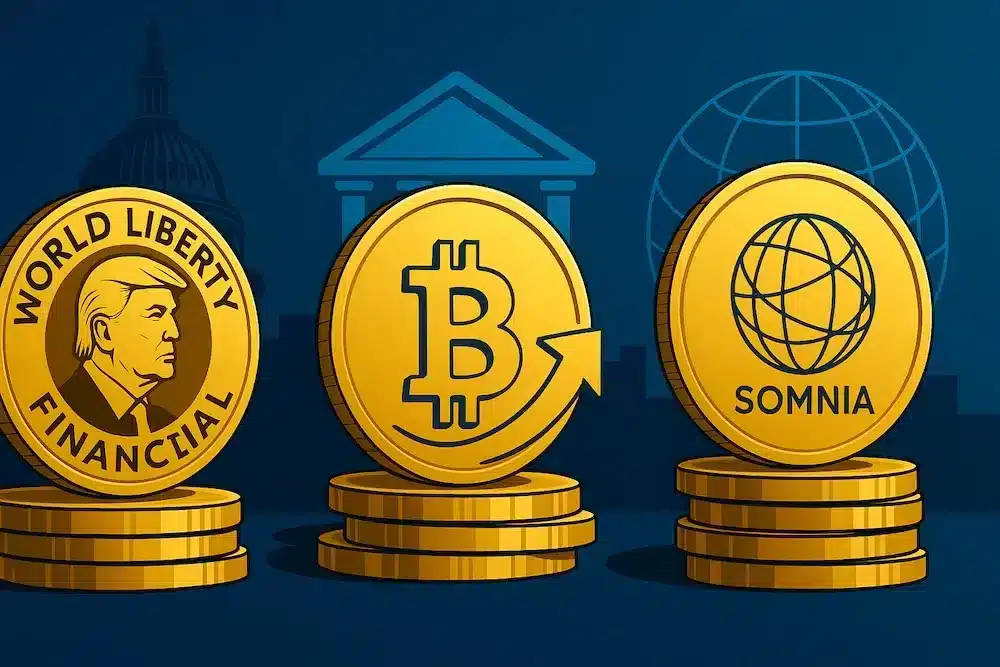
The cryptocurrency market remains volatile, with investors reacting sharply to both opportunity and risk, three tokens have vaulted into the global spotlight in the first week of September: World Liberty Financial (WLFI), Remittix (RTX), and Somnia (SOMI). Each represents a distinct narrative—one controversial, one aspirational, and one speculative—but all three share a common trait: they are shaping the next chapter of retail investor sentiment heading into Q4.
WLFI: Political Power Meets Blockchain Blowback
World Liberty Financial entered the market with a bang. Backed by members of the Trump family, the token launched late August under the promise of blending patriotic branding with blockchain utility. What followed was a whirlwind of excitement, chaos, and controversy.
Within 48 hours of listing, WLFI surged over 60%, only to nosedive following the announcement of a 47 million token burn—an attempt by the foundation to limit short-term trading volatility. The initial narrative pushed by promoters tied WLFI to future ambitions such as the USD1 stablecoin and a broader political-financial ecosystem. That narrative unraveled swiftly.
Critics quickly pointed to a lack of transparency around token allocation and governance. The foundation, as it later confirmed, had allocated approximately 25% of total supply to wallets linked to family members and insiders—raising concerns among DeFi analysts and retail traders alike. When high-profile wallets, including one reportedly associated with Justin Sun, were blacklisted, the backlash was swift and highly public.
Sun, known for his aggressive trading and role in projects like TRON and Poloniex, alleged that his WLFI holdings—estimated at over $100 million—were frozen without warning. The WLFI team responded with a vague statement citing “anti-phishing protections” and claimed the wallet was associated with suspicious behavior. No formal evidence was provided.
The optics were poor. On social platforms and in crypto forums, comparisons to FTX and even Bitconnect began circulating. The term “Trump rug” started trending on X (formerly Twitter), and developer Bruno Skvorc went so far as to label the WLFI team “the new mafia” in a widely shared post.
As of Friday morning, WLFI is trading around $0.23, down nearly 40% from its post-launch high. Liquidity remains deep—trading volume exceeded $400 million in the past 24 hours—but sentiment has sharply turned.
“Any token that can blacklist holders without explanation contradicts the fundamental ethos of decentralized finance,” said Nita Rajan, an analyst at CoinDelta Research. “WLFI has managed to generate both mainstream attention and maximum distrust.”
Remittix (RTX): The PayFi Challenger Attracting Smart Money
While WLFI grabbed the headlines, another token has been quietly amassing capital and community: Remittix (RTX). In a crowded presale environment, RTX has distinguished itself through both numbers and utility.
To date, RTX has raised over $23.8 million through its ongoing presale campaign. The project positions itself as a PayFi token—a blend of decentralized finance and real-world payments—offering crypto-to-fiat transfers across over 30 countries, with the promise of near-instant settlement and full banking integration. The presale price currently sits at $0.1030, and over 645 million tokens have been sold to more than 25,000 holders.
Remittix is scheduled for its first centralized exchange listing in mid-September, with confirmed support from LBank and BitMart, according to insiders familiar with the matter. A mobile wallet is expected to enter beta in the coming weeks, featuring fiat conversions, QR-code payments, and real-time FX rates.
“Remittix isn’t a meme coin—it’s infrastructure,” said Jesse Delacroix, a former JPMorgan product lead now consulting for blockchain firms. “They’re doing what Ripple started, but in a decentralized format, and with much broader geographic flexibility.”
Analysts are split on valuation. Some forecasts peg RTX at $0.60–$1.20 within 6 months post-launch, assuming user adoption and technical execution align. Others caution that the token’s 30 billion total supply could weigh on price appreciation if circulation outpaces demand.
Nevertheless, early investor interest remains strong. Unlike many presales that rely solely on hype and roadmap promises, Remittix has demonstrated technical milestones ahead of schedule—including FX modules and KYC verification tools for wallet holders.
Somnia (SOMI): Metaverse Infrastructure or Overhyped Experiment?
A starkly different story has unfolded around Somnia (SOMI), a token launched alongside a new high-speed blockchain aimed at gaming, NFTs, and metaverse assets. On paper, Somnia’s specs are staggering: over 1 million transactions per second, low energy consumption, and EVM compatibility. The mainnet went live on September 1st.
Somnia’s price jumped from $0.39 to over $0.51 in the first 48 hours following its Binance debut, spurred by a 30 million token airdrop and the announcement that BitGo would support SOMI custody for institutional clients. The token’s float remains modest, with only 16% of total supply currently in circulation.
But volatility hit quickly. As of Friday, SOMI had dropped to $0.47, amid signs of weakening momentum. Technical indicators like the Relative Strength Index (RSI) dipped below 50, and flow metrics showed outflows from centralized exchanges, suggesting early traders are taking profits.
“Somnia may become the Solana of the metaverse—but right now, it’s behaving more like a coin in search of a use case,” said Alton Michaels, partner at EastPoint Capital.
Some community concerns have also emerged around centralization. While the chain’s speed is indisputable, block production is handled by a closed validator set—raising questions about censorship resistance and resilience.
Still, development is active. The Somnia SDK has been downloaded by over 12,000 developers, and multiple gaming studios have signaled intent to deploy assets on-chain in Q4.
A Market Divided by Narrative
The concurrent rise of WLFI, RTX, and SOMI reveals the fragmented mindset of today’s crypto investor. WLFI thrives on political branding and notoriety. RTX offers a real-world solution with enterprise logic. SOMI seduces with speed and vision—though utility remains pending.
Together, they present a trio of tokens embodying the current market landscape: speculative, controversial, and cautiously optimistic.
For traders, the message is clear. Retail investors may still chase meme magic, but capital is increasingly flowing toward tokens with execution, use-case, and transparency.
And in a market where trust is currency, only one of the three has yet to break it.