Community Trust ScoreVerified
OpenAI’s GPT-6 Astra model successfully corrected 7,024 failed robotic actions out of 12,163 analyzed in a new study released by researchers at Carnegie Mellon University, the University of Illinois Urbana-Champaign, and Bosch Research. The paper, titled AgentRoboCritic, was submitted as a preprint on Nov. 19 and provides a detailed breakdown of how the artificial intelligence system reacts when a robot fails to execute a commanded movement.
More coverage is filed under Finance.
The overall recovery rate stands at 57.7%, a figure that masks significant differences depending on the nature of the error. The model proved most effective at correcting grasp failures, recovering in 63.7% of such instances. In contrast, recovery rates dropped to 35.7% for alignment errors and 29.6% for failed contact effects, where a tool failed to produce the intended physical change in the environment.
Data sources and methodology
The research team compiled the dataset by collecting new runs on seven robot manipulation benchmarks and reanalyzing previously released GPT-6 Astra runs on five additional benchmarks. RoboDojo supplied 9,923 of the failed actions, which gives it the most weight in the pooled recovery rate. The study also included 1,989 officially scored trials that contained at least one annotated failure.
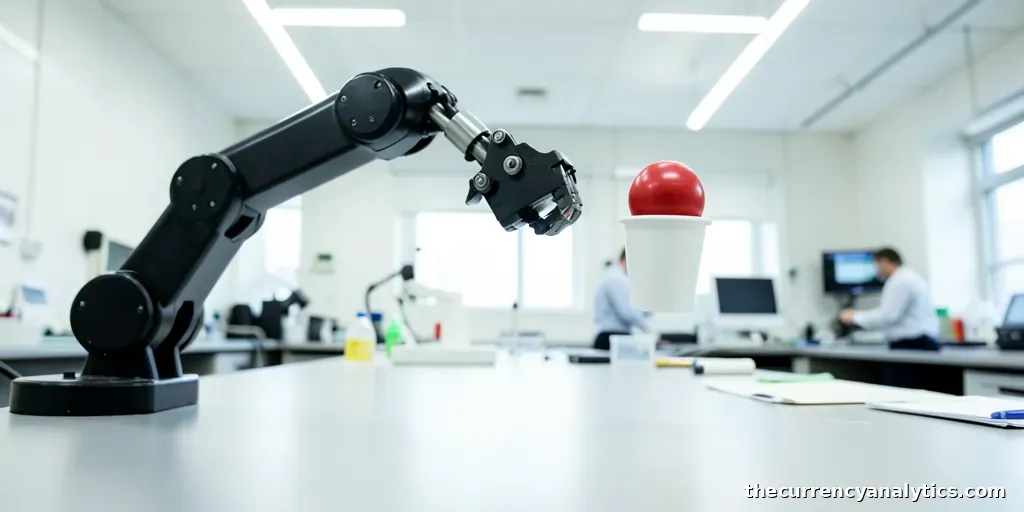
In this framework, a recovery is defined specifically. The researchers counted an action as recovered if a subsequent grasp visibly lifted the object or if the model employed a workaround to achieve the goal. For example, in one trial, Astra failed to grasp a ball inside a cup. Instead of retrying the direct grasp, the model lifted the cup with the ball inside to prepare for a pour. This workaround counted as a recovery, even though the overall trial might have ended in failure for other reasons.
The system operates by using robot observations to issue numerical commands, such as gripper position and opening distance. To judge whether an action was achieved, the researchers paired each action’s stated intent with observations taken before and after the move. This allows the model to assess the physical outcome against the intended goal.
Accuracy of automated labeling
The study also evaluates how well GPT-6 Astra can label its own actions compared to human judgment. On a separate set of 400 actions, the model’s labels matched initial human judgments on action outcomes 79% of the time. For the 264 actions that humans marked as failures, the model agreed on the specific type of failure 81% of the time.
These accuracy rates suggest the model can serve as a consistent critic for robotic behavior, though the gap between 79% and 100% indicates room for improvement in precise failure classification. The data shows that while the model is better at identifying that a failure occurred than it is at pinpointing the exact mechanical cause, it remains a useful tool for large-scale analysis of robot performance.
The findings highlight that alignment was the most common failure type in two benchmark settings that used vision alone. This suggests that when robots rely solely on visual input, they struggle more with positioning than with the physical act of grasping. The study does not include audio or other sensory inputs in these specific comparisons, focusing strictly on the visual data available to the model.
Related work mentioned in the text includes a separate study involving robots running Claude-written control programs after the coding agent left the loop. Another preprint, Mind2Act World, introduced 30 simulated manipulation tasks. That study found that its strongest agent struggled to maintain contact, a challenge that parallels the low recovery rate for failed contact effects seen in the Astra data. The current study does not test Astra against these specific simulated tasks but provides a baseline for how the model handles real-world or benchmark-derived failures.
The researchers did not provide a timeline for integrating these recovery mechanisms into commercial robotic systems. The preprint focuses on the analysis of past performance rather than future deployment. As of the submission date, the data represents a snapshot of GPT-6 Astra’s capabilities in manipulation tasks, with the primary contribution being the quantification of its ability to self-correct in a structured benchmark environment.