Community Trust ScoreLikely Real
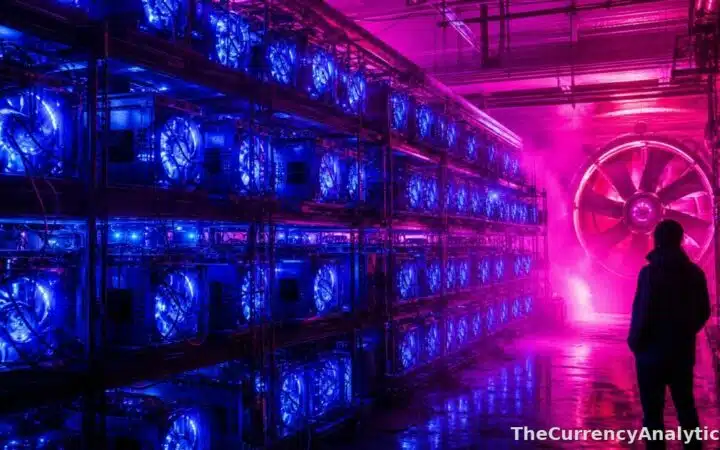
The Bitcoin mining industry is entering one of its most challenging phases yet, according to Fred Thiel, CEO of MARA Holdings (formerly Marathon Digital). As global competition climbs and energy costs continue rising, miners are seeing their margins tighten to levels that threaten long-term sustainability.
Thiel explained in a recent interview that Bitcoin mining operates as a “zero-sum game.” As more miners add computing power to the network, it becomes harder and more expensive for everyone else to stay profitable. With energy now the largest operational cost, the ability to control or generate power directly has become the biggest competitive advantage.
According to Thiel, miners who fail to secure low-cost, reliable energy will struggle to remain profitable—especially as the network’s hashrate keeps climbing to new highs.
Miners Shift Toward AI and High-Performance Computing
With margins tightening, many mining firms are diversifying beyond Bitcoin to survive. Thiel said an increasing number of miners are pivoting toward artificial intelligence (AI) and high-performance computing (HPC), where demand is growing rapidly.
These pivots allow miners to monetize their existing data centers by offering computing services that generate more predictable revenue than Bitcoin block rewards.
At the same time, major hardware manufacturers—and even companies like Tether—are deploying their own mining equipment at scale. This trend makes competition even tougher for smaller miners who cannot keep up with the cost of the latest hardware.
“Hardware vendors are running their own mining operations because customers aren’t buying as many machines,” Thiel noted. “As global hashrate climbs, everyone else’s margins shrink.”
The 2028 Bitcoin Halving Could Push Miners to the Breaking Point
Thiel warned that conditions may worsen significantly after the next Bitcoin halving in 2028. During each halving cycle, Bitcoin reduces the block reward paid to miners by 50%. In 2028, that reward will fall to just above 1.5 BTC per block.
This drastic drop will put immediate pressure on miners’ revenue. Unless Bitcoin’s price rises sharply—or transaction fees increase enough to compensate—many miners could be forced out of business.
“Bitcoin was designed with the assumption that transaction fees would eventually replace block subsidies,” Thiel said. “But that still hasn’t materialized in a meaningful way.”
While the network has seen temporary spikes in transaction fees due to trends like Ordinals and inscriptions, these periods haven’t sustained long enough to replace mining rewards.
Thiel highlighted the possibility of banks or financial institutions pre-purchasing block space to guarantee priority settlement, which could create a more stable revenue model for miners. However, such a scenario remains speculative.
Smaller Miners Face a Difficult Road Ahead
In the current environment, smaller mining companies face increasing risk. With rising competition, growing energy requirements, and high capital costs for modern hardware, many lack the scale needed to stay profitable.
Larger miners are adapting by securing their own energy sources, forming partnerships with power producers, or building private infrastructure for AI and HPC workloads. These steps help reduce reliance on third-party power providers and diversify revenue streams.
The long-term trend, Thiel said, is clear: miners who fail to secure affordable energy or expand into new computing sectors will be at risk of shutting down.
“Our strategy is to stay in the lowest quartile of production costs,” Thiel emphasized. “In a tight market, that means 75% of the other miners will have to shut down before we do.”
Energy Control Becomes the Key to Survival
Thiel said that by 2028, the mining landscape will look very different. The combination of falling block rewards and rising competition will likely force a massive consolidation across the industry. Only miners with direct access to energy will be able to operate profitably.
“By 2028, you’ll either be a power generator, be owned by one, or be partnered with one,” Thiel said.
This marks a major shift from earlier eras of Bitcoin mining, when small, independent operators could compete with modest equipment. Today, mining has become a capital-intensive, industrial-scale business where energy efficiency and operational scale determine survival.
A Future of Consolidation and New Business Models
Looking forward, Thiel believes the mining industry will continue to evolve alongside Bitcoin’s economic design. As profitability thresholds rise, the market will self-regulate: inefficient miners will exit, while stronger operators will continue expanding into energy production, AI computing, and other digital infrastructure opportunities.
For now, the message is clear. With halving cycles reducing rewards and competition intensifying each year, Bitcoin miners must rethink their business models, secure long-term energy strategies, and explore new revenue streams—or risk being pushed out well before the next halving.